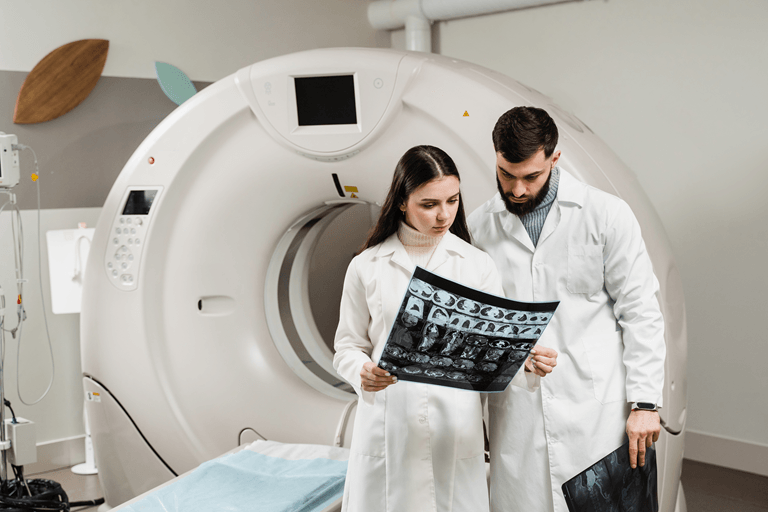
MRgFUS gives us the ability to offer a safe, non-invasive treatment option to patients with neurological movement disorders. Unlike traditional brain surgery, we don’t need to drill or cut into a patient’s skull to perform surgery. MRgFUS even eliminates the use of implants or radiation that are traditionally present in a lot of surgical procedures. Its non-invasive technology provides a very high level of accuracy, and it is made possible by utilizing MRI.
MRI is an integral, ongoing component of the entire procedure. It helps us see and track the area we need to target. MRI helps us confirm that the focused ultrasound energy is actually impacting the area we want to while leaving healthy brain tissue unharmed. Because we have the ability to be that precise and accurate, we know that patients will likely experience far less recovery time versus a traditional surgery, and the likelihood of complications is dramatically lower.
What is MRgFUS?
MRgFUS non-invasively performs surgery by utilizing high-intensity focused ultrasound, while also using MRI in real-time to help guide the procedure. MRgFUS allows us to treat a small target area of the brain with very concentrated ultrasound waves.
Planned Movie Scenes
Prior to any procedure, brain MRIs help show the surgery team where the brain’s problem area is located with the least amount of damage to the rest of the brain. The area of the brain that is causing the problem for the patient is located with the highest amount of precision.
Picture It: A “Thermal” Frame
With the help of MRIs, doctors can monitor and control the brain’s temperature. Therefore, doctors know exactly how much heat is applied to the area of the brain to provide the best treatment and the least amount of damage to the rest of the brain.
Quick View, then Move.
MRI’s real-time imaging of the brain allows doctors to see the area of the brain that was just closed off or “sliced”.
Things that May Lead to an MRgFUS
Most uses of MRgFUS are for patients whose tremors have caused substantial problems in their day-to-day life, and the use of outside treatment has shown no improvements.
Symptoms of this include:
-
Loss of control of hands -
Difficulty with the act of writing -
Difficulty with the act of eating or drinking -
Difficulty holding things -
Difficulty with everyday things -
Dependence because of loss of control of hands
An assessment of the brain is needed to see if MRgFUS will be a solution to the problem.
How are People Accepted to this Procedure?
Prior to the MRgFUS procedure, the diagnosing neurologist needs to see if there are any other problems with the patient that have been missed and see if the patient meets the criteria for the MRgFUS.
The assessment can include:
-
Comprehensive medical history -
Neurological Assessment -
Review of current medications -
MRI brain scan -
Assessment of the severity of the tremors -
Evaluation of general health status
Not all patients with Parkinson’s Disease or Essential Tremor are eligible for the procedure. Careful selection of patients is essential to attain the desired outcomes.
MRI-Guided MRgFUS Benefits
The combination of MRI and focused ultrasound has numerous benefits:
-
Highly accurate treatment -
No incision -
No implanted devices -
Ability to visualize and monitor treatment in real time -
Less injury to surrounding brain tissue -
Usually a shorter hospital stay -
Usually a shorter recovery period compared to open brain surgery
For these reasons, MRgFUS is a viable treatment option for patients with significant tremors.
When to See a Neurologist
A neurologist should be consulted when tremors limit the ability to perform tasks, when medications are no longer helpful or if the symptoms continue to worsen. An early assessment may provide the cause of tremors and the need for other treatment options such as MRgFUS.
Conclusion
Movement disorders have improved with the development of MRgFUS and MRI technology. MRI allows physicians to monitor and provide real-time and precise guidance for the procedures, which helps to protect healthy brain tissue during the treatment.
MRgFUS at Royal Care Neurosciences
At Royal Care Neurosciences, our team is focused on patients with movement disorders. We have an experienced team of neurologists and neurosurgeons. We provide patients with advanced treatment options, such as MRI-Guided Focused Ultrasound. Rather than surgery, we focus on the diagnosis and the individual. Our goal is to provide patients with the best quality of care in order to provide them with an improved quality of life.
Frequently Asked Questions
1. Why is MRI used during MRgFUS treatment?
Starting with the MRI, doctors have an image of the brain to view in real time as they proceed with the treatment. This also allows the doctor to monitor the heat in the treatment area.
2. Which conditions can be treated with MRgFUS?
Patients suffering from Parkinson’s tremors and essential tremor are the focus of treatment with MRI-Guided Focused Ultrasound when they do not find relief with traditional treatments.
3. Is MRgFUS a surgical procedure?
MRgFUS does not qualify as an invasive surgery like other traditional brain surgeries. This is because no cuts or openings are made on the body. This also allows for a faster recovery time for MRgFUS patients.