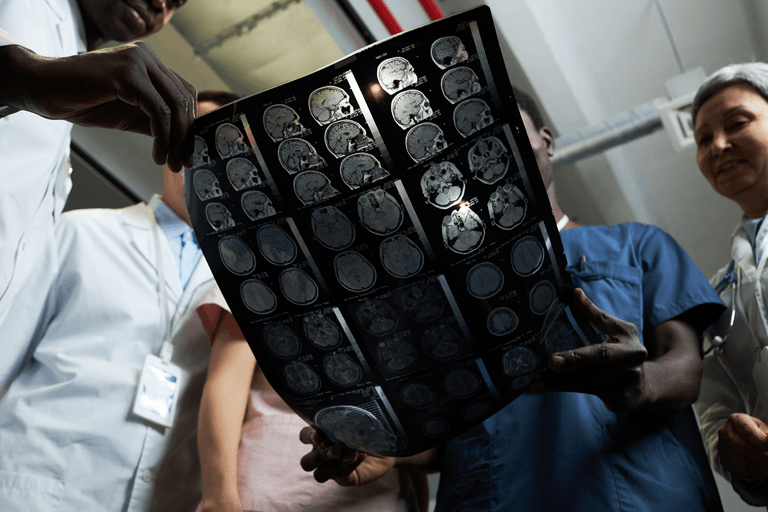
First-time seizures can come out of the blue and be scary. Most seizures are caused by something other than brain tumours. However, a case can be made for brain tumours causing seizures. Brain tumours can disrupt normal brain activity and, in some cases, actually stimulate abnormal electrical activity.
Seizures with brain tumours happen. How long it takes a brain tumour to stimulate seizure activity is dependent on the tumour’s type, size and location and how the tumour affects nearby brain tissue.
Seizure Stimulation
The brain is extremely orderly, sending signals using electricity. Disrupting this order, either directly or indirectly, can cause an electrical disturbance and stimulate a seizure.
A brain tumour may grow to a size that presses on the brain. A brain tumour may also cause swelling. Either of these scenarios can disrupt the signals traversing the brain.
Seizures are commonly seen with brain tumours that disrupt the functioning of the cerebral cortex. Seizures have also been documented with brain tumours in non‐cortex locations, so seizure activity does not necessarily help locate the brain tumour.
Recognizing a Seizure
Seizures come in many forms. Not every seizure looks the same. Some people might experience muscle spasms or stiffness of an arm or leg, while others might lose awareness and stare. Some seizures and their symptoms are more apparent to other people, like jerking, confusion, inability to communicate, etc. There are several other symptoms that come along when experiencing a seizure. Some people might experience unusual sensations or even smell or taste something that is not there. You might recognize people experiencing seizures because of some of the symptoms, like blurred vision or loss of consciousness. Once a seizure has passed, some people feel completely drained or confused, as if they have no energy.
Some seizures are more apparent and last a significant amount of time, but some seizures can last only a few seconds. You should always get medical help after the seizure to get checked out just in case, even if you recovered fast.
Is Just One Seizure Considered Epilepsy?
Absolutely not epilepsy is a neurological condition of having repeated unprovoked seizures. Let’s say you have a brain tumour; you might even have a seizure, but whether you get labelled as having epilepsy really depends on a number of other factors. Sometimes doctors take a wait-and-see approach.
Epilepsy tends to affect people individually in different ways.
This is important to understand because different treatment plans are warranted.
How Do Doctors Identify If Seizures Are Related To Brain Tumours?
When people experience unexplained seizures, doctors take the opportunity to investigate the occurrence before, during and after are the most crucial times. The observations of friends or family members are often the most useful to a doctor.
A doctor may also prescribe a neurological exam to check thousands of things, including strength, coordination, speech, memory, as well as the sensory system.
Depending on the symptoms, doctors often encourage brain scans and other supporting imaging. An MRI scan is the most commonly used type of brain imaging when looking for structural causes of brain tumours. A CT scan may also be done when a doctor urgently needs to assess a patient.
An EEG or Electroencephalogram is used to document brain activity. By documenting and assessing the brain activity, doctors may also infer if seizures may occur or possibly what type of seizures. However, an EEG is not sufficient to diagnose or rule out a brain tumour.
If an imaging test indicates a brain tumour, additional tests and procedures may be needed. Often a biopsy is recommended so that a sample of the growth can be assessed.
What Happens If A Brain Tumour Causes Seizures?
To treat seizures and tumours, doctors rely on the symptoms that cause the seizure. This means that anti-seizure medications are likely to be prescribed first, to reduce seizures while other potential tumour treatments such as radiotherapy, surgery, and other harmful modalities will be undertaken.
In the end, treatment of seizures can restore the patient to their previous quality of life and independence that was negatively affected by frequent seizures.
Patients should also heed their doctor’s directions when it relates to medication and safety. Based on the laws of the jurisdiction and the patient’s history of seizures, some activities, such as driving, may need to be restricted or prohibited.
When Should You Seek Medical Help?
For the first seizure, that is always the case. Other situations that need immediate medical attention are continuous seizures that last minutes, numerous seizures that occur without recovery, seizures that result in serious injury or seizures that occur with severe breathing problems.
A seizure does not mean a person has a brain tumour. Other causes of seizures may be epilepsy, infections, metabolic disturbances, certain medications, and other neurological conditions. Seizures caused by brain tumours may occur without other symptoms. So assessment is of utmost importance.
At Royal Care Neurosciences, a detailed clinical assessment and proper investigations can help the doctors evaluate the possible cause of seizures and recommend the most appropriate clinical management for each patient.
Frequently Asked Questions
1. Can a brain tumour present with seizures with no other signs or symptoms?
Yes. A seizure may be the first recognizable symptom of a brain tumour. However, having a seizure does not mean a person definitely has a brain tumour. Imaging is needed to determine the cause.
2. Can seizures caused by brain tumours be managed?
Most of the time, seizures caused by brain tumours are manageable with anti-seizure medications while the tumour is being treated. The treatment course is decided on a case-by-case basis and is based on the tumour and the patient.
3. Does every person with a brain tumour develop epilepsy?
Not every person with a brain tumour develops epilepsy. Most brain tumour patients do not experience seizures at all. Risk factors would include tumour growth, tumour site, and how much tumour growth impacts surrounding brain tissue. A doctor would be able to evaluate how much of a risk an individual poses.