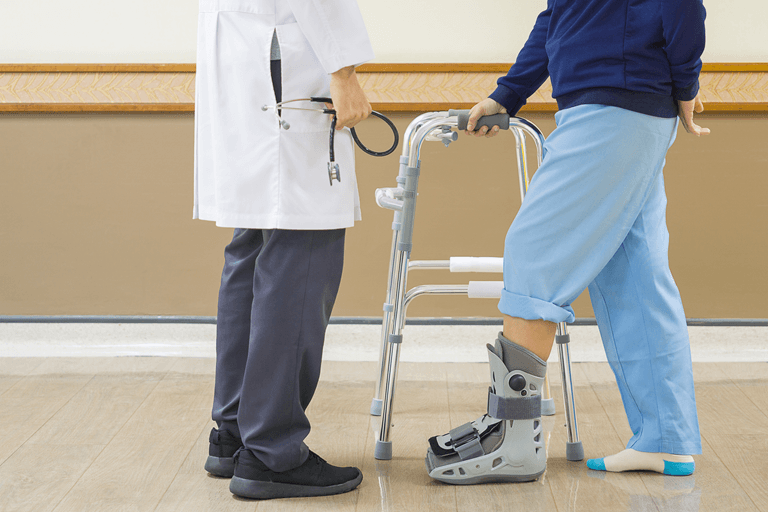
Parkinson’s Disease, like many other neurodegenerative disorders, is most famously associated with tremors and loss of control over one’s muscles. However, in addition to these symptoms, many also experience something called Freezing of Gait (FOG). Freezing of Gait occurs when a person feels an involuntary urge to continue walking, but is physically unable to move their legs. Many report feeling as if their feet have been glued to the floor.
While freezing episodes of FOG generally last a small number of seconds, they can be debilitating and increase the risk of falling. FOG can be very disruptive to daily life. For many, the best way to deal with FOG is to understand what causes it, recognize the symptoms, and most importantly seek help if it is offered.
Freezing of Gait Defined
Freezing of Gait is an episode in which the movement of walking is interrupted. This can be experienced in countless different situations, but it is most commonly experienced when one is attempting to walk for the first time, if one is to pivot or turn their body, when one is walking through a doorway, and even when walking in a crowded place. This occurs when the brain is unable to connect to the muscles and send the signal to help them move.
Many people who have been diagnosed with Parkinson’s Disease exhibit symptoms of FOG, but not all do, and not all will exhibit them at the same stage of the disease.
Freezing of Gait Causes
While no one thing can be pointed to as the main cause of FOG, a combination of several things can contribute to the disease.
Lack of Dopamine
One of the hallmark symptoms of Parkinson’s Disease is a lack of dopaminergic activity. Dopamine plays a huge role in helping one maintain smooth, healthy, and coordinated movements. A decrease in dopamine means a decrease in one’s ability to control their movements, and consequently their ability to walk normally.
Parkinson’s Disease Progression
Freezing of Gait episodes are most commonly seen during the advanced stages of Parkinson’s Disease. However, in some cases, individuals may begin to experience FOG episodes early on.
Medication Changes
Some may notice that freezing typically happens at the end of a dose and prior to the next dose of Parkinson’s medication.
Environmental Triggers
Freezing episodes may happen more often in cramped spaces, crowded places, and when stress increases, especially if a person is being rushed.
Symptoms of Freezing of Gait
Some of the common symptoms include the following:
-
Inability to move -
Feet Stuck -
Difficult Time Starting to Walk -
Walking with Stopped or Shuffling Steps -
Freezing Once Already Turned or Approached a Door -
Poor Balance -
Falling
These symptoms of freezing gait can reduce self-confidence and increase difficulty accomplishing daily tasks.
How Is Freezing of Gait Diagnosed?
Observing the walking pattern of the patient will help the neurologist determine the diagnosis of freezing gait.
This may include the following:
-
Review of Medical history -
Examination of the Neurological system -
Assessment of Gait and Balance -
Assessment of Parkinson’s Medication -
MRI Scan
Patients may have to describe what they were doing or where they were when thawing occurred. Some patients may have to provide a recorded video of a thawing episode.
Management and Treatment
Freezing gait is not a thawing episode that can be easily prevented, or, in other words, is not a thawing episode that has a significant impact.
When freezing gait happens due to the withdrawal of Parkinson’s medication, changing the medication may be helpful. Physiotherapy may include special walking exercises or balance and freezing exercises, which may be overcome with the use of visual or rhythmic cues. Maintaining regular exercise at home to remove obstacles and using supportive footwear to eliminate the risk of falling may thaw the freezing episode.
When To Go See A Neurologist
You should go see a neurologist if you frequently experience episodes of freezing, consistently fall especially if these falls are new, or have noticeable difficulty when walking (especially if this is a new symptom). The benefit of seeing a neurologist sooner rather than later is that your treatment plan can be tailored to address your symptoms of walking and/or falling sooner.
Summary
Freezing of Gait or Feldy’s freezing, which is commonly found in Parkinson’s, will decrease confidence, and while independent living may still be possible, it will also very likely impact the overall quality of life. While freezing of gait can never be cured, being able to modify medications, along with regular PT and an active lifestyle, can greatly improve the quality of life of the patient.
Royal Care Neurosciences has neurologists with a great deal of experience with not only Parkinson’s but with many other movement disorders. Through timely and accurate assessments and customized treatment options, patients are able to achieve significant symptomatic relief and improvement in their overall movement as well as their quality of life.
Questions
1. What does it mean when a Parkinson’s patient has freezing of gait?
It means that when a patient tries to walk, they will experience a moment of paralysis in which they feel as though their feet are stuck to the ground.
2. Can freezing of gait be improved?
Freezing of gait can absolutely be improved! A combination of medicine, PT, exercise, especially targeted gait therapy, and walking can be a great improvement.
3. Is freezing of gait more likely to be the cause of falling?
Yes. Freezing of gait definitely will impact the gait of a person and balance and is highly likely to make falling much more likely. The sooner treatment is started, the better the improvement in safety will be.