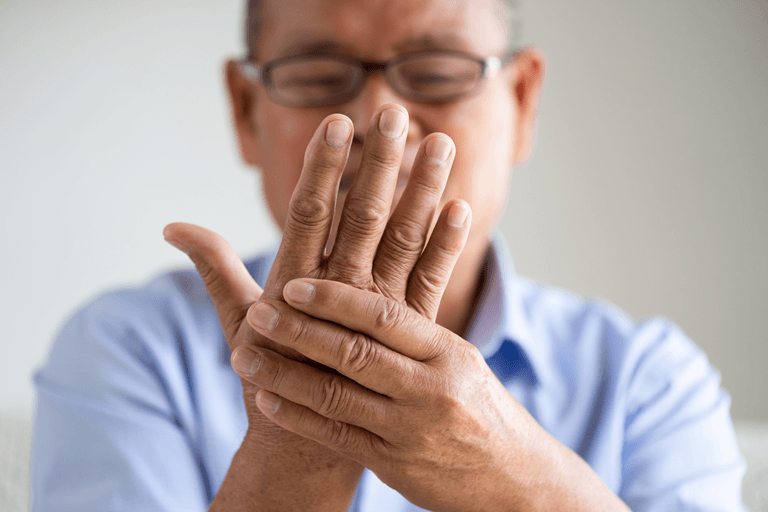
Because of how Parkinson’s Disease is portrayed in society, many people think of it as simply another name for hand tremors, or slower movement, or shuffling strides. They do not notice the condition’s more nuanced symptoms, which develop first. Most people think these symptoms are just an unfortunate part of ageing or something that happens when someone is stressed or tired. These symptoms can be early warning signs of the disease, but many people do not realize that noticing these changes is critical to managing the disease as best as possible so that their quality of life remains as high as possible.
At Royal Care Neurosciences, awareness is the first step to better care. Knowing the symptoms is so important so that other people can seek medical attention as soon as possible.
What is Parkinson’s Disease?
Parkinson’s Disease is a neurodegenerative disease that affects the patient’s ability to control their movements. This happens when the cells in the substantia nigra lose their ability to produce dopamine, a chemical that is necessary for muscle movement. This is why people with this condition have slower movements and less control. The condition can develop before many of the more obvious symptoms, and the early warning signs can occur years before the more obvious symptoms.
Things You Should Never Overlook
When it comes to Parkinson’s disease, the symptoms of the condition can vary in all people. Many of the symptoms range from mild to severe and can take a long time to develop. Below are the most common early symptoms; most of them can be missed.
1. Mild Jerking
A jerk or a tremor that’s mild can be noticed and is a common early sign of the disease, and it might start by jerking or shaking an entire hand, finger or even a chin. The tremors could be noticed while resting and can persist while someone is moving. Some people start noticing it when they start shaking the thing they are holding, or when their hand is in a relaxed position.
2. Slow Movement
When someone is trying to do something, and it is taking longer than it is supposed to, it might be Parkinson’s. People with the condition are unable to perform some simple tasks like writing or walking to their destination. They may even be aware of the unconsciously fast movements and quick movements, like blinks to arm swinging while walking.
3. Muscle Rigidity
If a person is not moving and they feel stiffness in their body, it can even happen in parts of the body where there’s no movement and the person can feel discomfort and be unable to move due to the stiffness. Some people feel tightness in their neck or shoulders, and it can happen in areas of the body where they do not even know the reason.
4. Changes in Handwriting
Writing could become smaller and more cramped. It could even become more difficult to read. This sign is called micrographia and is a sign that is often overlooked.
5. Loss of Smell
An early, non-motor symptom of Parkinson’s is the loss of a person’s ability to smell. This can include being unable to identify familiar scents like coffee or spices.
6. Sleep Disturbances
People in the early stages of Parkinson’s disease may experience extended periods of restlessness. Sudden movements or even combating others in their dreams may occur. Oftentimes, the partner reports these disturbances before the individual even realizes.
7. Soft or Low Voice
Speech may become softer and more monotone. In some instances, speech may become slightly slurred. Affected individuals may be operating at a much quieter level than their peers.
8. Changes in Facial Expression
People who experience a diminished ability to show or even create facial expressions can develop a “masked face.” This may be a sign that a person is feeling serious and even less emotional when, in fact, they feel completely the opposite and normal.
9. Constipation
Persistent constipation without a clear dietary cause may develop Parkinson’s, and may not seem to be related, but it is often present in early stages.
Key Factors Influencing the Development of Parkinson’s Disease
Though it is unclear what exactly causes Parkinson’s Disease, the following categories are known Parkinson’s risk factors:
-
Age: The risk of developing Parkinson’s Disease increases with age. The risk is most significant for individuals older than 60 than for younger individuals. -
Genetics: A very small number of individuals with Parkinson’s Disease have family members with the same illness. -
Environmental Exposure: People who have worked with/around pesticides are known to have developed the illness at a higher frequency than the average person. -
Gender: Men are statistically slightly more likely to be ill than women.
The presence of one or more of these risk factors does not guarantee that an individual will develop Parkinson’s Disease.
How is Parkinson’s Disease Diagnosed?
In the early stages of the illness, diagnosing Parkinson’s can be very difficult. The illness has no single definitive test. Diagnosing the illness is mostly based on a doctor’s evaluation of the patient’s medical history.
-
Neurological Examination – The neurologist will evaluate the patient’s movements, muscle tone, coordination and reflexes. All of the above will be evaluated for the presence of characteristic signs (i.e. tremors and movement that is noticeably slower than average). -
Medical History – The patient’s symptoms, the history of similar symptoms, and the family history of neurological illnesses will be evaluated by the doctor. -
Response to Medication – A doctor is allowed to provide symptomatic relief to the patient. This is referred to as symptomatic relief and supports the diagnosis. -
Imaging Tests
More time for better adjustment to treatment and lifestyle changes, as well as better management of symptoms, can be achieved with an earlier diagnosis.
Why Early Detection is Important
Although there is presently no cure for Parkinson’s disease, the earlier it is detected, the better it can be managed. Active and fulfilled lifestyles are possible for many with the aid of prompt treatment and the appropriate medications, along with physiotherapy and the right adjustments to everyday practices.
Recognizing the early symptoms also helps families and patients understand the disease better, and because of that, they can be better prepared, not only emotionally, but also financially, to deal with the support and care that will be needed.
When is it time to speak to a doctor?
Seeing a neurologist is recommended if there are concerning symptoms such as tremors, stiffness, slow-paced movements, or if there are noticeable changes with speech or sleep. Early assessment is always better, even if it does not result in the diagnosis of Parkinson’s.
Conclusion
Parkinson’s disease can be difficult to diagnose because early symptoms are quiet and easily overlooked. Only a limited range of movement, voice changes, sleep disruption, and even smell are small, but these symptoms are important warnings to pay attention to. Seeing a doctor early is crucial and can make a difference in how well the disease is managed.
The team at Royal Care Neurosciences is focused on providing expert, individualized care and early diagnoses to patients at all levels of Parkinson’s disease.
Frequently Asked Questions (FAQs)
1. Does Parkinson’s disease always start with tremors?
The answer is no. At the start, there are a small number of people who experience tremors. They may begin to notice a rigidity of the body, a slowness of movement, and changes to the way that the individual speaks and to their facial expressions.
2. Are the early symptoms of Parkinson’s disease reversible?
The answer to this is also no. Parkinson’s disease is not reversible; however, there are many ways to manage the disease early on to control some of the symptoms and to slow down how quickly the disease progresses.
3. How early can Parkinson’s disease be detected?
There are a number of non-motor early symptoms, such as loss of smell and sleep disturbances, that can appear many years before the motor symptoms, and as a result, the loss of control of movement symptoms appears, so early medical evaluation is key to early diagnosis.